



When we look in the mirror, some of us have a clearly defined double-eyelid crease while others have a smooth single eyelid (monolid). Even the same person may have a crease on only one side, or develop one later in life. So how exactly does a double eyelid form? It may look like a simple matter of "having one extra line or not," but a surprisingly intricate anatomical structure is hidden inside the eyelid. Drawing on a medical paper about the principle of double-eyelid formation, this article explains in plain terms how a double eyelid comes about.
1. Looking Inside the Eyelid — How Single and Double Eyelids Differ
The upper eyelid is made of two layers. The outer anterior layer is the skin we can touch plus the muscle that closes the eye (the orbicularis), and the inner posterior layer consists of a firm plate that shapes the lid (the tarsus) and the tendon that opens the eye (the levator aponeurosis).
The key to a double eyelid lies in the connection between these two layers. When the skin of the anterior layer attaches to the "eye-opening tissue" at a certain height, opening the eye makes the skin above that point fold inward — creating the crease we call a double eyelid. If the connection is absent or weak, the skin simply drapes over the eye, giving a single eyelid.
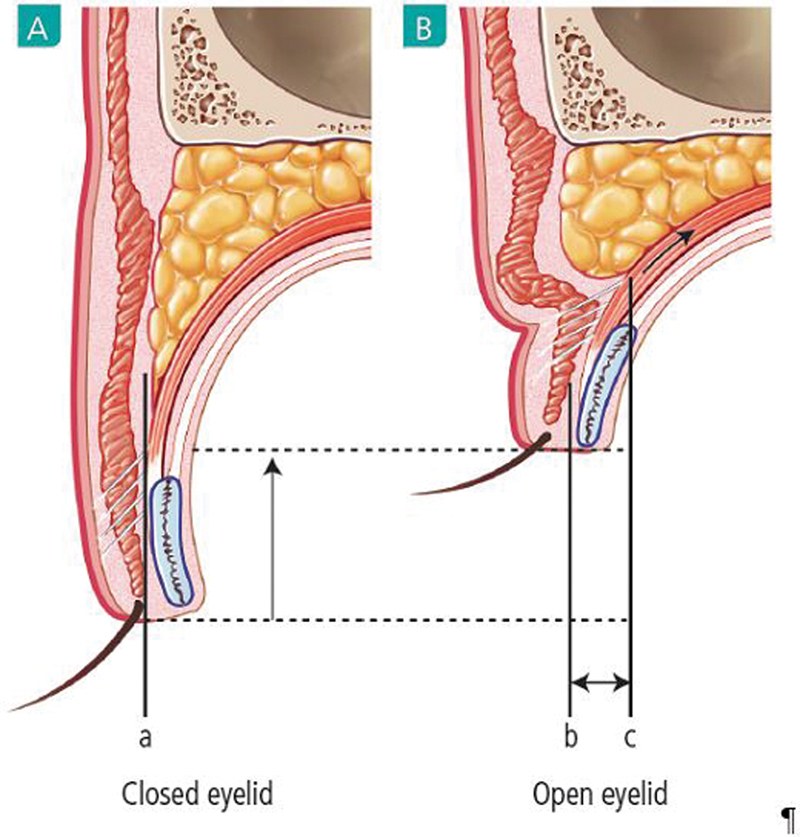
▲ Cross-section of the upper eyelid when closed (left) and open (right). Opening the eye folds the skin above the connection point, forming the crease.
There is also an anatomical reason single eyelids are more common among East Asians. East Asian eyelids tend to have relatively thicker skin and fat in the anterior layer, and the membrane linking the two layers sits lower, so a natural connection (double eyelid) is less likely to form.
2. The Core of Double-Eyelid Formation: "Adhesion"
The way the anterior and posterior layers attach is called adhesion in medicine. The paper classifies it into three forms.
- Point adhesion — the weakest form, attached at only a few points. It suits thin eyelids, but the weak link can let the crease gradually fade.
- Linear adhesion — attached along a single line. The most balanced connection, keeping the crease stable.
- Planar adhesion — the strongest form, attached over a wide area. It lasts long, but if too broad it can create excess scar tissue.
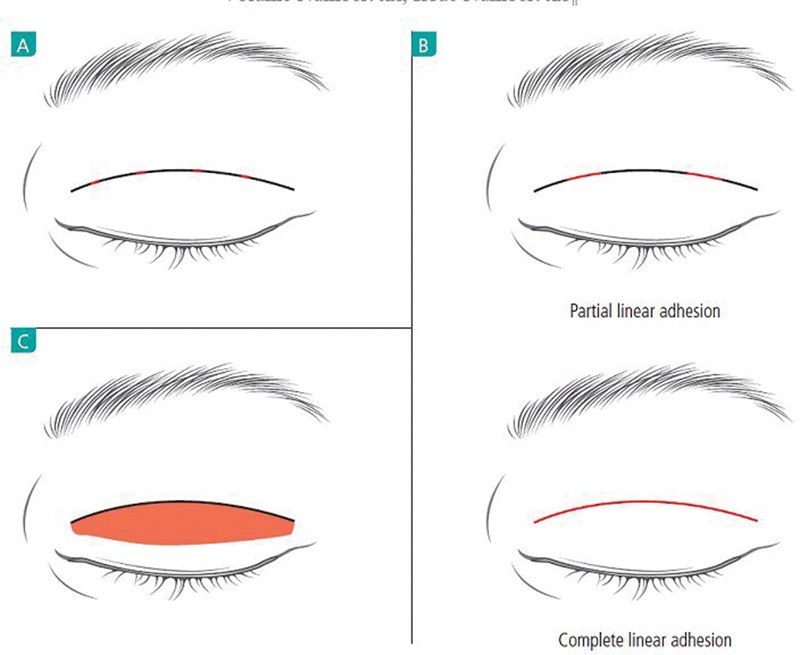
▲ Forms of adhesion (shown in red) between the layers. Whether point, line, or plane determines how stable the crease is.
Whether a double eyelid arises naturally or is created surgically, the essence is the same: appropriately connecting the anterior-layer skin to the eye-opening tissue.
3. In-fold vs. Out-fold — Types of Crease
Not all double eyelids look alike. By where the line starts and how it curves, they fall into three main types.
| Type | Characteristics | Impression |
|---|---|---|
| In-fold | The front of the line tucks inside the epicanthal (Mongolian) fold and fans outward. Most common among East Asians. | Natural, soft |
| Out-fold | Open at the front, with the line running parallel or higher toward the outside. | Defined, bright |
| In-out (middle) | Between in-fold and out-fold, with little change in height. | Natural yet defined |
The height of the line matters too. A high line makes the eyes look more defined and larger but takes longer to recover and may create a puffy "sausage eyelid." A low line recovers faster and looks natural, but the skin above it is a little more prone to drooping over time. Rather than one being "correct," the right shape depends on the eye shape, face, and skin thickness.
4. How a Natural Crease Line Is Designed
The paper also suggests where a natural-looking crease should sit. In general, the line is described as starting 2–3 mm from the inner corner of the eye and ending 4–6 mm past the outer corner for a balanced result. Going too far beyond this range can look unnatural.
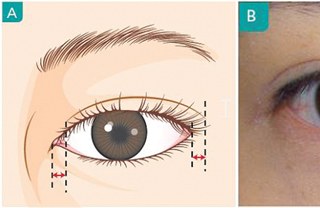
▲ Designing the crease line's start and end points. The distance from the eye corners governs how natural it looks.
5. Why a Crease Fades Over Time
Interestingly, one of the hardest problems the paper emphasizes is that "every eyelid crease becomes somewhat shallower over time." This is closer to a natural phenomenon than an abnormality. A crease tends to fade more readily when the skin is thick, the person is young, the eyelid has abundant soft tissue or fat, or there is skin sagging.
So understanding "how a double eyelid forms" also makes it easy to understand why creases settle differently from person to person — and change over time — even on eyes that look alike.
In Summary
A double eyelid is not a mere "extra line" but the result of an anatomical structure: how the anterior and posterior layers of the eyelid are connected. The difference between single and double eyelids, in-fold versus out-fold, and why creases fade — all of it rests on one principle, the "connection" (adhesion).
This content is provided for general medical information only. It does not recommend any specific procedure and is not a substitute for diagnosis or treatment. Eye conditions and suitable approaches differ from person to person, so an accurate assessment requires consultation with a medical professional.
The text and figures of this article are based on the following open-access paper.
Cho I. Principle and Mechanism of Double Eyelid Formation. Arch Plast Surg. 2023;50(2):142–147. doi:10.1055/s-0042-1751100.
Figures © 2023 The Author(s), used under the CC BY 4.0 license; color conversion, resizing, and partial cropping were applied for web publication.