



Looking in the mirror, some people have a high, well-defined nasal bridge, while others have a low bridge and a rounded tip. Why do noses—all of them "a nose"—look so different? The truth is that the nose is not a simple lump of flesh but a three-dimensional structure precisely assembled from bone and cartilage. Once you understand how the nose is built, it becomes easy to see why noses differ so much from person to person, and what rhinoplasty actually reshapes. This article walks through the bones and cartilages that make up the nose.
1. The nose is a two-layer structure: bone on top, cartilage below
The framework of the nose differs from top to bottom. The upper part (about one-third) is hard bone—the nasal bone—while the lower part (about two-thirds) is cartilage. That is exactly why the upper bridge feels firm when pressed, while the tip feels soft.
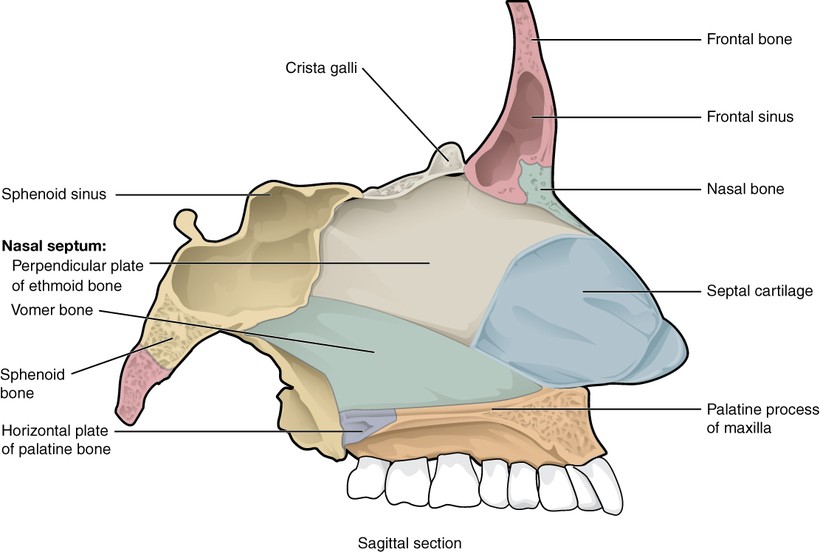
▲ Cross-section of the nose. The upper portion is the nasal bone; the lower portion continues as cartilage (blue). The nose is built jointly from bone and cartilage.
This is why rhinoplasty addresses different elements depending on the area. Augmenting the bridge mainly means placing an implant or autologous cartilage over the bone and soft tissue, whereas tip surgery means reshaping and repositioning the cartilage below.
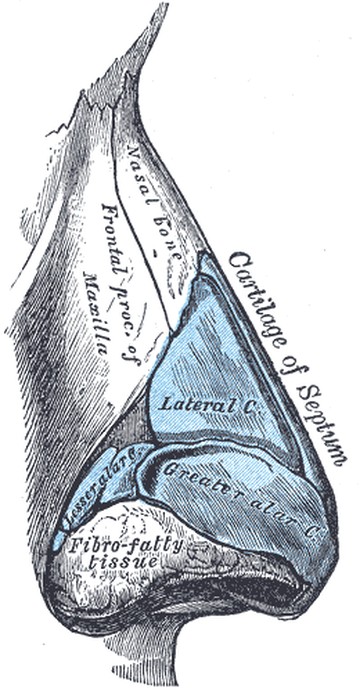
▲ Side view of the nasal cartilages (blue). Below the nasal bone, the upper lateral cartilage continues, and the lower lateral (alar) cartilage sits at the tip.
2. The lower lateral cartilage shapes the nasal tip
The impression of the nasal tip is determined mostly by a pair of cartilages called the lower lateral (alar) cartilages. These cartilages arch around each nostril, and depending on their size, shape, angle, and firmness, the tip can look pointed or round, high or low.
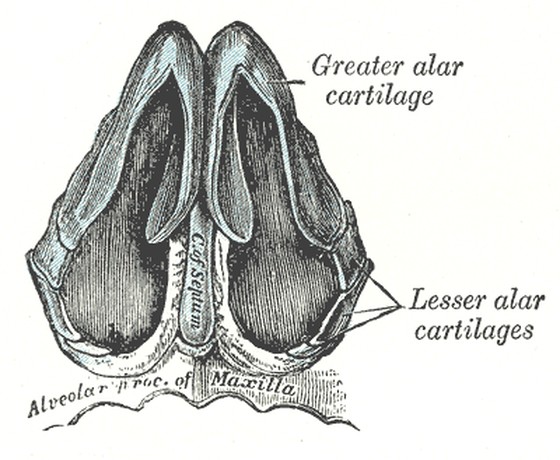
▲ The nose seen from below. A pair of lower lateral (greater alar) cartilages wrap around the nostrils and form the shape of the tip.
Tip surgery brings these cartilages together with sutures, trims part of them, or adds a cartilage graft to change the height and direction of the tip. In other words, it is less about cutting away flesh and more about rearranging the cartilage "framework."
3. The septum: the central pillar of the nose
Down the middle of the nose stands the nasal septum, which divides the two nasal passages. The septum is made of the septal cartilage in front and bone (the perpendicular plate of the ethmoid and the vomer) behind, and it acts as the central pillar that supports the whole nose from within.
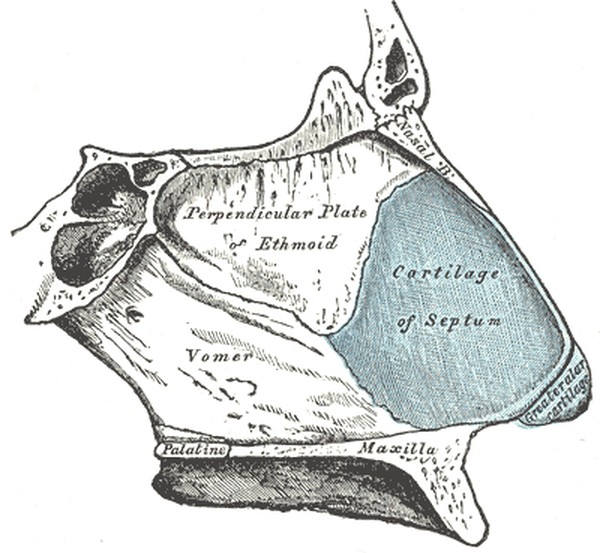
▲ The nasal septum. The front is the septal cartilage (blue); the back is bone (perpendicular plate of the ethmoid and vomer). It is the pillar that supports the nose from within.
When the septum deviates to one side, the nose may look crooked or become blocked. At the same time, septal cartilage is firm yet easy to shape, so in rhinoplasty it is often used as a support strut for the tip or as graft material.
4. Anatomical features of the East Asian nose
The structure of the nose is the same in everyone, but its proportions and thickness vary by individual and ethnicity. In general, the noses of East Asians, including Koreans, tend to show the following traits.
- A relatively low bridge — the nasal bone and septal cartilage are comparatively small and low, so the bridge often forms at a lower height.
- Thicker skin and soft tissue — when the tip skin is thick, the underlying cartilage shape shows through less, making the tip look round and bulbous.
- Weaker tip cartilage — when the lower lateral cartilages are small and soft, they have less strength to support the tip on their own.
Because of these features, East Asian rhinoplasty often aims to augment the bridge and support the tip upward, using autologous cartilage (septal, ear, or rib) or an implant to make up for the limited support.
5. The proportions of a natural nose
There is no single "correct" beautiful nose, but medicine does describe proportional guidelines that tend to look natural and balanced.
- Front view — the nose looks balanced when the width of the alar base is roughly equal to the distance between the inner corners of the eyes.
- The nasolabial angle (between the columella and the upper lip) — an angle of roughly 95–105° in women and 90–95° in men is considered natural. If this angle is too wide, the tip looks over-rotated and the nostrils become prominent.
- The nasofrontal angle (between the forehead and the bridge) — the side profile looks smooth when the curve from the forehead to the bridge is neither too deep nor too flat.
What matters is not forcing your nose to match these numbers, but finding the balance that suits each face's proportions, skin thickness, and cartilage condition. The same bridge height can suit one face and not another.
In summary
The nose is not a single "lump" but a three-dimensional structure layering bone (nasal bone), cartilage (upper lateral, lower lateral, and septal cartilages), and skin. The reason noses differ from person to person—and the reason rhinoplasty is closer to "reshaping and supporting a framework" than to "cutting away"—both come from this structure. Understanding how the nose is built lets you look at your own nose, and its possibilities, more calmly.
This content is intended to provide general medical information only; it does not recommend any specific procedure and is not a substitute for diagnosis or treatment. The condition of the nose and the appropriate methods differ from person to person, so an accurate assessment requires consultation with a medical professional.
The medical information in this article draws on the following open-access (CC BY) literature and standard anatomical references.
· Nikparto N, et al. The current techniques in dorsal augmentation rhinoplasty: a comprehensive review. Maxillofac Plast Reconstr Surg. 2024;46(1):16. (CC BY 4.0)
· Villegas-Alzate F. The TRICK-TIP Rhinoplasty. Aesthetic Plast Surg. 2024;48:3098–3108. (CC BY 4.0)
Illustration credits: color cross-section © OpenStax, Anatomy & Physiology (CC BY 3.0); nasal cartilage and septum plates from Henry Gray, Anatomy of the Human Body (1918), public domain. Color conversion and resizing were applied for web publication.