




Eye-opening surgery: what to know if small, closed-looking eyes concern you

What kind of eyes do you think “small, closed-looking eyes” refers to?
This term combines “cockle” and “eyes” in Korean, referring to eyes that are small and not opened at the inner or outer corners,
giving them a closed-off appearance.
To improve small, stuffy-looking eyes like these,
many people look into eye-opening surgery.
However, excessive opening can make the impression look strong and may cause discomfort
in daily life, so the procedure should be decided on carefully.
Before discussing eye-opening surgery, let’s talk about the types of eye opening.
Eye-opening procedures include lower canthoplasty, lateral canthoplasty, dual canthoplasty, and medial epicanthoplasty.

First, let’s look at lower canthoplasty.
Lower canthoplasty at Hyundai Aesthetic Surgery lowers the lower eyelid at the outer part of the iris, around the outer one-third of the lower eyelid margin,
aiming for a softer eye shape.
Depending on each person’s eye condition, it can lengthen the horizontal width of the eyes and lower the outer corners, reducing the upward slant
so a softer, gentler-looking eye shape can be expected.
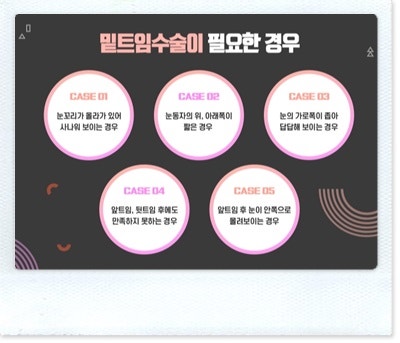
1. When the outer corners of the eyes are raised, making the impression look sharp
2. When the vertical width above and below the iris is short
3. When the eyes look stuffy because the horizontal width is narrow
4. When you are not satisfied even after medial or lateral canthoplasty
5. When the eyes appear too close together after medial epicanthoplasty
these may be cases where lower canthoplasty is needed.
Second, let’s look at lateral canthoplasty.
Hyundai Aesthetic Surgery’s anti-adhesion lateral canthoplasty is performed when the horizontal length of the eyes is short and slightly upturned.
It opens the closed-looking outer corner through an incision
and fixes it to the outer periosteum, aiming to extend the horizontal length of the eyes.
By suturing inside the eyelid with dissolvable threads,
it also aims to ease the burden of returning to daily life.
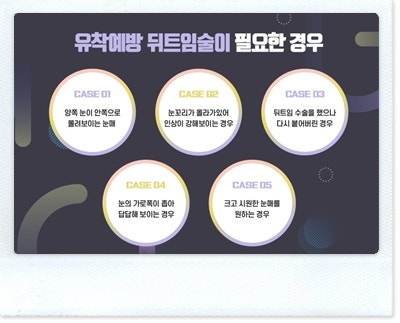
1. Eyes that appear pulled inward toward the center
2. When the outer corners of the eyes are raised, making the impression look strong
3. When the eyes have reattached after previous lateral canthoplasty
4. When the eyes look stuffy because the horizontal width is narrow
5. When you want larger, more open-looking eyes, these may be cases where lateral canthoplasty is needed.
Third, let’s look at dual canthoplasty.
Hyundai Aesthetic Surgery’s dual canthoplasty increases both the horizontal and vertical width of the eyes at the same time, aiming for larger, more open-looking eyes,
and it is an eye surgery that aims to soften sharp and fierce-looking eyes into a gentler impression;
through canthoplasty, softer and more open-looking eyes can be expected.
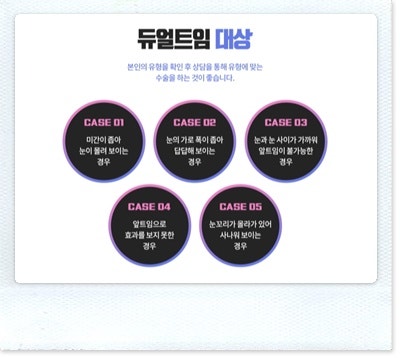
1. When the eyes appear close together because the space between the brows is narrow
2. When the eyes look stuffy because the horizontal width is narrow
3. When medial epicanthoplasty is not possible because the eyes are close together
4. When medial epicanthoplasty did not produce the desired effect
5. You may need dual canthoplasty in cases where the outer corners of the eyes are upturned, making the impression look sharp or fierce.

Fourth, let’s take a look at epicanthoplasty.
Hyundai Aesthetic Surgery’s epicanthoplasty differs from conventional epicanthoplasty by using an inner incision to reduce the scar burden,
and by making a minimal incision in the upper eyelid and releasing the Mongolian fold, it widens not only the horizontal width but also the vertical width,
aiming for larger, clearer-looking eyes.
Because swelling and the scar burden are relatively low, returning to daily life tends to be less of a burden, and with this procedure a stuffy, sharp impression
can be expected to change toward a clearer and softer one.
1. When the horizontal width of the eyes is narrow
2. When the space between the eyes looks wide due to Mongolian folds
3. When the front part of the eye slopes down sharply, making the impression look sharp
4. When you want a more open and refreshed eye shape by combining it with double-eyelid surgery
5. You may need this epicanthoplasty in cases where you want an epicanthoplasty procedure with a lower scar burden.
Canthoplasty is a highly preferred surgery, so it is important to choose
the eye canthoplasty procedure that is appropriate for you.
In addition, after a one-on-one personalized consultation with medical staff who have extensive experience in eye surgery, your eye structure,
eye shape, and facial proportions should be considered in planning canthoplasty,
which is an important step.
If you are looking into canthoplasty, consult with Hyundai Aesthetic Surgery to receive detailed guidance on the recovery-care process.
https://youtu.be/X_DTg9rfoNs
https://youtu.be/srtqOWuQxoE