



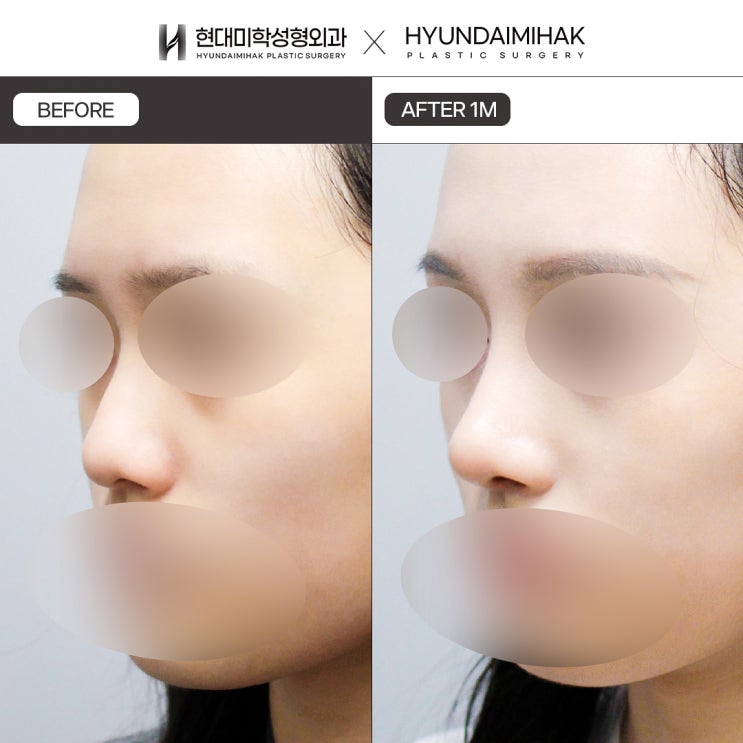
Before and After Closed Rhinoplasty: Incisions Inside the Nostrils

Hello, this is Hyundai Aesthetic Surgery. In rhinoplasty, there are countless different materials that can be used for the nasal bridge and nasal tip, and there are also many differences and various approaches in surgical methods beyond implants or graft materials. Because of this, many people struggle to find the nose surgery that is right for their own nose. Some may also hesitate to undergo rhinoplasty because they worry about scars remaining from the incision or its traces after surgery. Perhaps for this reason, many patients contact us after looking up before-and-after cases of closed rhinoplasty. Today, we will explain while reviewing such before-and-after cases of closed rhinoplasty.

First, when looking at before-and-after results of closed rhinoplasty, you can see that the incision site is clearly different. Rhinoplasty performed with a closed approach involves making incisions inside the nostrils. Therefore, when comparing before-and-after cases of closed rhinoplasty, unlike open rhinoplasty, you can observe that no incision line is left on the columella skin. In addition, when performing open rhinoplasty, the inside of the nose can be clearly checked. This allows for a more delicate and precise procedure.

However, when rhinoplasty is performed with a closed approach, it is difficult to visually confirm the internal structure of the nose, so the skill of the specialist performing the surgery is truly important. Therefore, we recommend checking similar before-and-after cases of closed rhinoplasty and the surgical plan at a consultation.

Closed rhinoplasty is generally well suited to simpler surgical cases, but it can also be performed for more challenging cases such as a crooked nose or hump nose, so it is best to determine suitability through a detailed consultation with a specialist. Since the skill of the specialist is important for this type of closed rhinoplasty, we recommend receiving consultations at several clinics and comparing them. When choosing those clinics, carefully check factors such as the specialist’s experience and consult with medical staff you can trust.

Also, as in before-and-after cases of closed rhinoplasty, there are patients for whom a closed approach may be suitable, but for cases that require changing the nasal structure, an open approach is more appropriate. Therefore, it is important to visit the clinic in person and confirm the exact details through consultation and CT imaging. Closed rhinoplasty has the advantage of making minimal incisions inside the nostrils, so bleeding tends to be less of a concern and returning to daily life tends to be less burdensome. In the case of open rhinoplasty as well, the incision is made on the columella area, which is not very noticeable, and the scar tends to lighten gradually over time, though the degree varies from person to person, so please decide carefully which surgical method to choose.

Likewise, if you want a natural nose shape and quick recovery as shown in before-and-after cases of closed rhinoplasty, we also recommend implant-free rhinoplasty. Implant-free rhinoplasty uses only autologous tissue as the graft material for the nasal bridge and tip, so natural postoperative results can be expected and recovery tends to be less burdensome. If you would like a slightly more glamorous nose shape, it would be best to receive a consultation and decide on the implant or graft materials. Thank you.


