



Let’s first identify the cause before considering epicanthoplasty revision surgery.

Hello.
This is Hyundai Aesthetic Surgery.
Even if you have had double eyelid surgery,
if you are stressed because your eyes still look small,
you may consider eye-opening procedures.
Eye-opening procedures can help open up eyes that look closed-off
and improve them into a more refreshed eye shape.
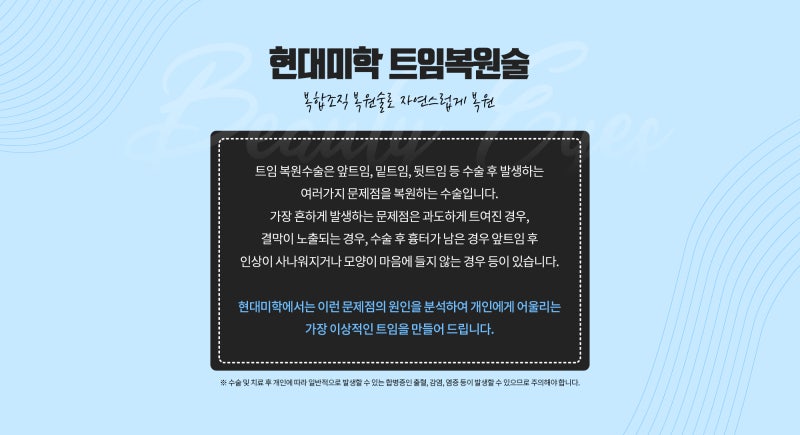
Eye-opening procedures are divided into epicanthoplasty, lateral canthoplasty, lower canthoplasty, and dual canthoplasty,
and because each person has a different eye shape
and different harmony among their facial features,
the appropriate method for improvement may vary.
With eye-opening procedures, even a 1 mm difference
can change your overall image, so before proceeding,
it is best to carefully and accurately understand
your own eye shape first.
If the procedure is not performed properly,
we may need to consider epicanthoplasty revision surgery.
Epicanthoplasty revision refers to a surgery performed after epicanthoplasty
that appropriately restores the removed Mongolian fold
and improves the excessively opened skin at the inner corner of the eye
back toward its original appearance.
If the initial eye-opening procedure is performed excessively
or too aggressively, it may lead to unsatisfactory results,
making revision surgery necessary.

Before undergoing not only epicanthoplasty revision but also lateral canthoplasty revision, lower canthoplasty revision,
or dual canthoplasty revision,
it is important to have a thorough consultation and
properly identify your specific concerns.
When eye-opening procedures are performed,
there can be various causes of unsuccessful outcomes,
so let’s look at when revision is performed
and what methods are used.
Hyundai Aesthetic Surgery’s canthoplasty revision surgery restores various problems that may occur after procedures such as epicanthoplasty, lower canthoplasty, and lateral canthoplasty.
It is a surgery that restores these concerns.
The most common problem
is when the eyes have been opened excessively.
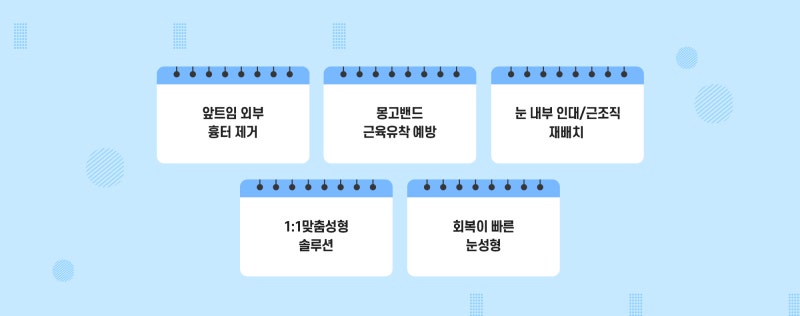
In addition, revision may be considered when the conjunctiva is exposed,
when scars remain after surgery, or after epicanthoplasty
when the impression becomes too sharp or the shape is not satisfactory.
At our clinic, we analyze the causes of these concerns
and perform restoration with the most ideal canthoplasty revision
that suits each individual.
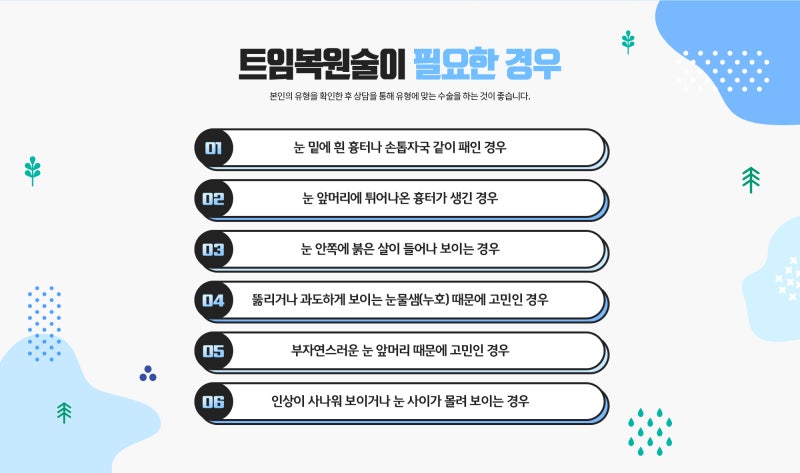
In general, canthoplasty restoration may be needed
when there are white scars or nail-mark-like indentations under the eyes,
when a raised scar has formed at the inner corner of the eye,
when the red tissue on the inner side of the eye appears exposed,
when you are concerned about an exposed or overly visible lacrimal caruncle,
when you are concerned about an unnatural-looking inner corner of the eye,
or when the eyes make the impression look harsh or the distance between the eyes appears too narrow.
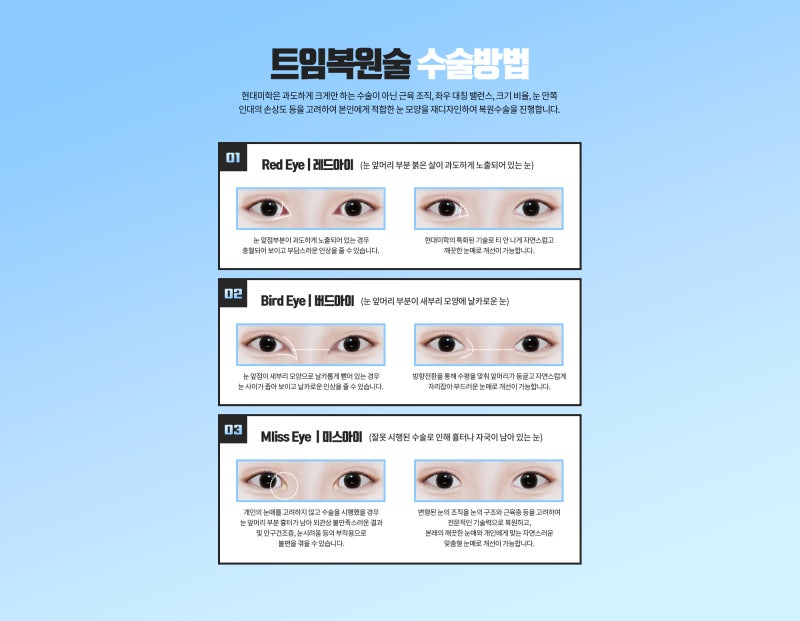
The canthoplasty restoration procedure performed at our clinic
is not a surgery that simply enlarges the eyes excessively; rather, it considers the muscle tissue,
left-right symmetry balance, size ratio, and the inner eye ligament
as well as the degree of damage,
redesigning the eye shape that is appropriate for each patient and performing restoration surgery
accordingly.
The surgical method for canthoplasty restoration
varies depending on the cause.
Unlike canthoplasty, restoration is highly complex,
so it is important to approach it with great caution.
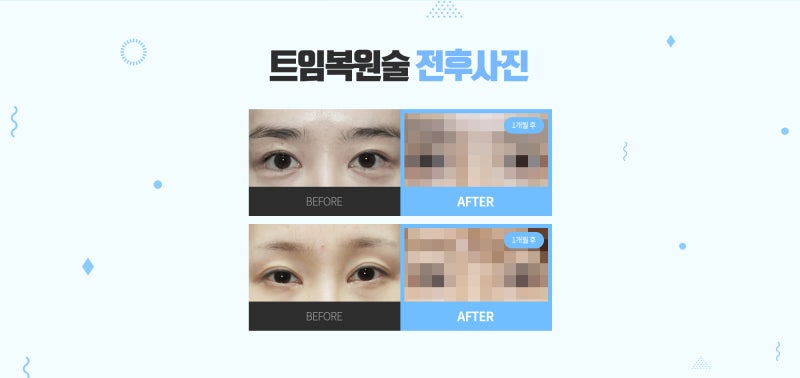
Before proceeding with restoration, it is important to carefully assess
what caused the need for restoration and how the eyes should be redesigned,
as well as which method should be used for restoration,
then plan meticulously
before carrying out the procedure.
For those who have been considering epicanthoplasty restoration surgery,
and have been thinking about it,
why not visit a clinic known for excellent epicanthoplasty restoration
Hyundai Aesthetic Surgery
and discover another side of yourself?
https://youtu.be/X_DTg9rfoNs
https://youtu.be/7VBswJ9kmcw