



As non-face-to-face activities such as working from home and online classes have increased due to COVID-19, more people are choosing plastic surgery over travel.
Interest is especially high in eye correction surgery, which makes a heavy-looking eye shape appear more open and defined. Unlike double-eyelid surgery, whose main purpose is cosmetic improvement by creating a line that makes the eyes look more beautiful and refreshed, eye correction is primarily a corrective procedure intended to change a sleepy-looking impression caused when the muscle that opens the eye is weak, short, or degenerated, resulting in less exposure of the dark part of the iris when opening the eyes with the same effort.
When eye correction is performed, overcorrection can occur during surgery due to insufficient or excessive adjustment of the eye-opening muscle, neurological factors, or anatomical differences in eyeball size. If overcorrection occurs, the eyes may look as if they are wide open even without intentionally applying force.
This type of overcorrection can also look aesthetically unnatural and leave a strong impression. In addition, various functional problems may occur, including recurrence of eyelid drooping, dry eye syndrome, decreased vision, and headaches.
Immediately after eye correction surgery, swelling may make the eyes appear mildly overcorrected. In such cases, it is recommended to monitor progress for about 6 months, as the eyelids often come down on their own as the swelling improves. However, if the eyelids do not come down over time, if the eyes remain so wide open that the white of the eye is visible above the iris, or if lagophthalmos occurs, where the white of the eye remains visible even when the eyes are closed, re-correction to reduce the overcorrection (eyelid retraction surgery) may need to be considered.
If overcorrection is severe immediately after surgery, re-correction should be performed within 1 month before skin adhesion develops. Once more than a month has passed, adhesion becomes more severe and precise correction becomes difficult, so in this case it is appropriate to undergo re-correction after at least 6 months.
Relatively mild overcorrection can be re-corrected with eyelid retraction surgery, but severe cases may require surgery to release the eye-opening muscle. Therefore, when visiting a clinic for overcorrection, it is important to proceed with a surgical method suited to you through an in-depth consultation.
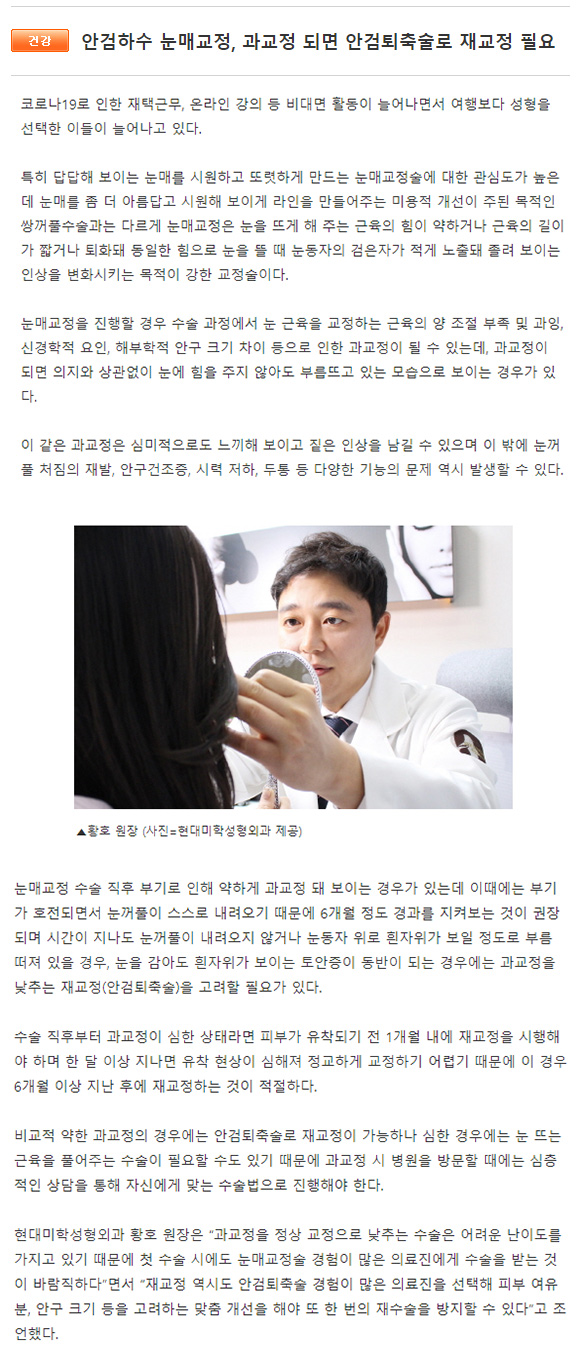
Director Hwang Ho of Hyundai Aesthetic Surgery advised, “Surgery to lower overcorrection to a normal correction level is technically difficult, so it is advisable to receive eye correction from medical staff with extensive experience even for the first surgery,” adding, “For re-correction as well, choosing medical staff with extensive experience in eyelid retraction surgery and receiving customized improvement that considers factors such as available skin and eyeball size can also help prevent another revision surgery.”
▲ Press article (2021.03.02) Source unknown · Reported on 2021.03.02 · Original article mdtoday.co.kr
Information related to Hyundai Aesthetic Surgery Clinic: Gangnam eye surgery information