



Among men and women in their 20s and 30s, eye surgery was found to be the most desired area of cosmetic surgery. In fact, eye surgeries such as double-eyelid surgery, canthoplasty, and ptosis correction are known to be among the most frequently performed cosmetic procedures.
Among these, as various canthoplasty procedures such as epicanthoplasty, lateral canthoplasty, and lower canthoplasty, which create a wider and more open-looking eye shape, have continued to develop and are being actively performed, revision and restoration surgeries are also increasing.
In canthoplasty, epicanthoplasty opens the Mongolian fold, a skin tissue that blocks the inner corner of the eye in a beak-like shape, especially when the distance between the eyes is wide, and corrects the eyes to an appropriate proportion when they appear far apart. Satisfying results can be achieved only when the surgery is performed after comprehensively considering the size and shape of the eyes and the shape of the Mongolian fold.
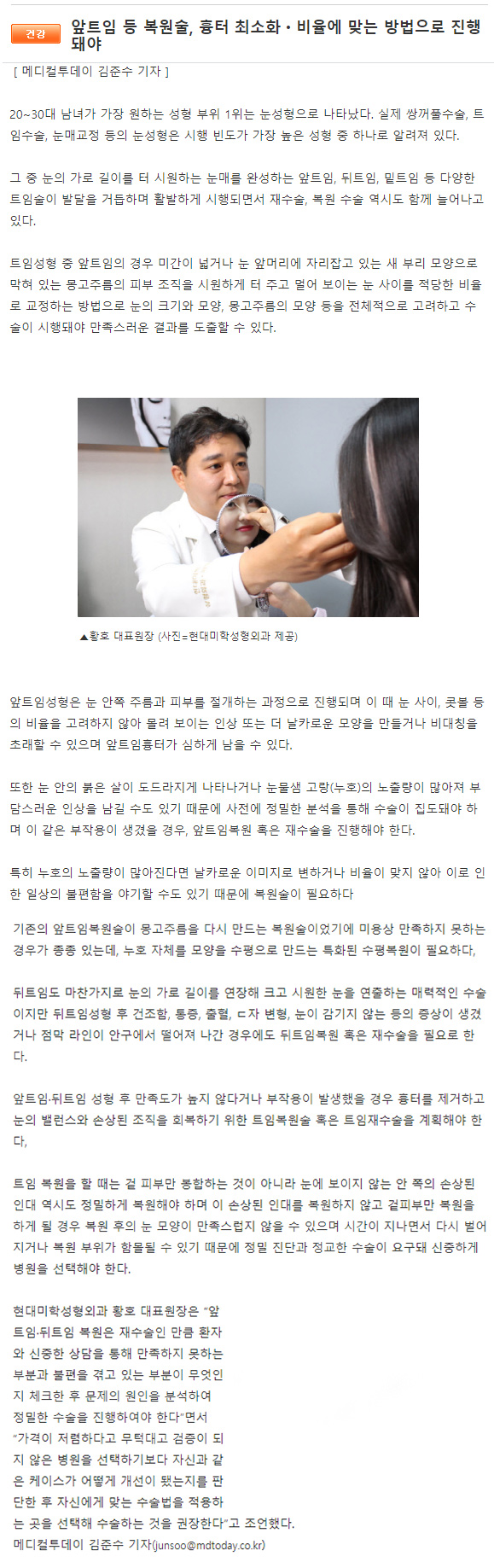
▲ Chief Director Hwang Ho (Photo provided by Hyundai Aesthetic Surgery)
Epicanthoplasty is performed by incising the inner eye fold and skin. If the proportions between the eyes and the width of the nasal alae are not considered at this stage, it may create an impression that the eyes look too close together, make the eye shape appear sharper, cause asymmetry, or leave severe epicanthoplasty scars.
In addition, the red tissue inside the eye may become more prominent, or the lacrimal caruncle area may become excessively exposed, creating an uncomfortable impression. Therefore, surgery should be performed based on a precise preoperative analysis, and if such side effects occur, epicanthoplasty restoration or revision surgery is needed.
In particular, if the lacrimal caruncle becomes overly exposed, it can create a sharper image or disrupt the facial proportions, which may lead to daily discomfort, making restoration surgery necessary.
While conventional epicanthoplasty restoration recreated the Mongolian fold, patients were sometimes not satisfied aesthetically. In such cases, a combined horizontal restoration that makes the lacrimal caruncle itself appear more horizontal is needed.
Lateral canthoplasty is also an appealing procedure that extends the horizontal length of the eyes to create larger, more open-looking eyes. However, if symptoms such as dryness, pain, bleeding, a C-shaped deformity, or difficulty closing the eyes occur after lateral canthoplasty, or if the mucosal line separates from the eyeball, lateral canthoplasty restoration or revision surgery is needed.
If satisfaction is low after epicanthoplasty or lateral canthoplasty, or if side effects occur, canthoplasty restoration or revision surgery should be planned to remove scars and restore the balance of the eyes and damaged tissue.
When performing canthoplasty restoration, it is not enough to suture only the outer skin; the damaged ligaments inside, which are not visible, must also be precisely restored. If the damaged ligaments are not restored and only the outer skin is repaired, the restoration scar may not be satisfactory, and over time the area may reopen or the red tissue may become depressed. Therefore, accurate diagnosis and delicate surgery are required, and the clinic should be chosen carefully.
Chief Director Hwang Ho of Hyundai Aesthetic Surgery advised, “Because epicanthoplasty and lateral canthoplasty restoration are revision surgeries, it is important to have a careful consultation with the patient, check which areas are unsatisfactory and causing discomfort, analyze the cause of the problem, and then perform precise surgery.” He added, “Rather than choosing an unverified clinic simply because the price is low, it is recommended to select a clinic that can determine how cases similar to yours have improved and apply the surgical method that suits you.”
▲ Medical Today article (2021.03.18) Source: Medical Today · Reported on 2021.03.18 · Reporter Kim Jun-su · Original article at mdtoday.co.kr
Information related to Hyundai Aesthetic Surgery Clinic: Gangnam eye surgery information