



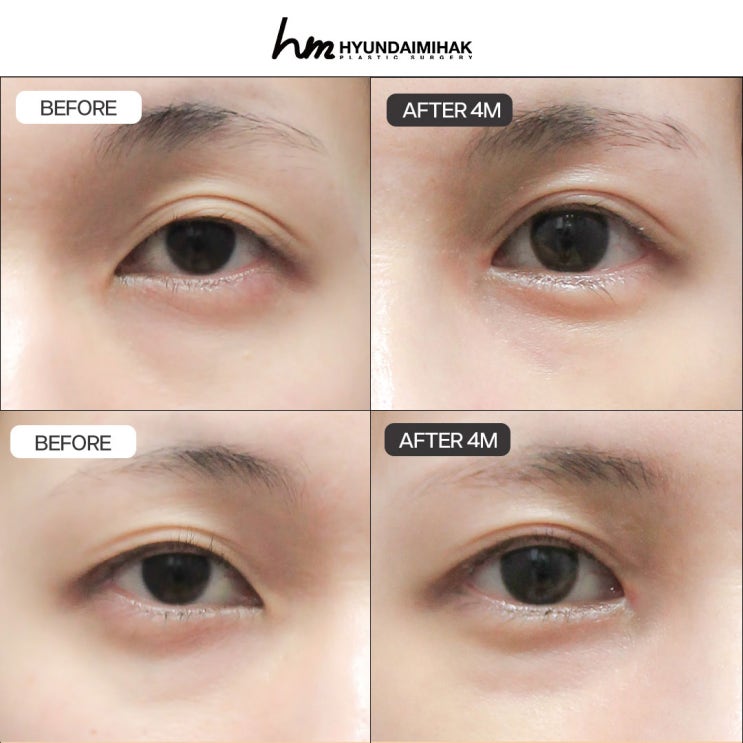
Hello, this is Hyundai Aesthetic Surgery. Epicanthoplasty revision surgery is not simply a cosmetic correction; it is a procedure that focuses on restoring an excessively incised inner corner of the eye and rebalancing the overall eye shape and impression. It is often sought by patients who feel that after epicanthoplasty, their eyes look too sharp, scars have become more noticeable, or the eye shape appears unnatural.
The procedure reconstructs the Mongolian fold area that was excessively removed in a previous surgery, or gently releases skin that has become tightened by scar tissue with the aim of restoring a natural inner eye corner line.
At Hyundai Aesthetic Surgery, epicanthoplasty revision surgery is performed with careful consideration of scar minimization, eye symmetry, the degree of pupil exposure, and the condition of skin adhesion.
When Epicanthoplasty Revision Surgery Is Needed
Epicanthoplasty revision surgery may be needed in the following situations.

- The inner corners of the eyes were opened too far and look sharp or fierce
- The epicanthoplasty scar stays red, or the inner corner looks folded instead
- The two eyes have become asymmetrical and look awkward
- The mucous membrane inside the eyelid is exposed, causing discomfort such as conjunctivitis
Because the inner corner of the eye has thin skin and frequent movement, revision surgery or reconstruction is much more complex than the initial procedure. At Hyundai Aesthetic Surgery, we first precisely diagnose the degree of tissue damage, then analyze the amount of skin that can be restored and the scar condition to create a customized surgical plan.
Surgical Method and Scar-Minimizing Techniques

The core of epicanthoplasty revision surgery is the design for restoring the Mongolian fold. At Hyundai Aesthetic Surgery,
① damaged scar tissue is delicately removed, and
② the remaining skin is used to redesign a natural curve.
Epicanthoplasty revision surgery at Hyundai Aesthetic Surgery is designed from the planning stage to harmoniously improve the overall eye shape, taking into account the length and angle of the eyes, the height of the nose, and facial proportions.
Recovery Process and Precautions

Immediately after surgery, swelling and slight bruising may occur, but they usually ease gradually within 3 to 5 days, and the pace of recovery varies from person to person. Stitches are removed after about 5 to 7 days, and by weeks 1 to 2, the scar often becomes lighter and the shape of the inner eye corner gradually settles. After about 1 month, it can usually be covered with makeup, and from around 3 months onward, a natural eye line gradually settles into place.
Hyundai Aesthetic Surgery provides an aftercare program to support recovery. Through step-by-step recovery care such as cold and warm compresses to reduce swelling, regenerative laser treatment, and scar tissue injection therapy, we help the results stay natural-looking.
Important precautions include avoiding rubbing the eyes or wearing contact lenses for at least 2 weeks, avoiding sleeping face down, and thoroughly protecting the area from UV rays. Especially right after surgery, scars exposed to UV rays may develop pigmentation, so sunscreen or sunglasses are essential.
Effects and Satisfaction of Epicanthoplasty Revision Surgery

Epicanthoplasty revision surgery aims for natural restoration of the eye shape. It can improve an artificial or overly strong impression and help the eye shape move closer to its original soft yet defined appearance. After surgery, patients can expect a gentler impression and a more natural eye shape, while how visible the scar remains differs from person to person.
In addition, many people consider surgery because of the discomfort they feel whenever they look in the mirror.
The results after surgery tend to last relatively long, though they may vary depending on skin elasticity and scar management. At Hyundai Aesthetic Surgery, medical staff who have focused on eye surgery for many years personally provide consultation, surgery, and aftercare, aiming for stable results.
Epicanthoplasty Revision Surgery: Why Choosing the Right Clinic Matters

Epicanthoplasty revision surgery requires much more delicate technique than general eye surgery. This is because existing scars must be corrected while restoring a natural line and left-right balance at the same time. Therefore, it is important to entrust the procedure to an experienced board-certified plastic surgeon. Hyundai Aesthetic Surgery offers convenient access just a 1-minute walk from Exit 1 of Sinsa Station, private one-on-one consultation rooms, and a dedicated recovery care system.
In particular, because we have accumulated many years of experience with diverse cases related to epicanthoplasty revision surgery, including eye shape analysis, scar restoration, and fat repositioning, we perform surgery with both safety and naturalness in mind.
In Summary

Epicanthoplasty revision surgery is a precise reconstructive plastic surgery that aims to improve various issues such as scars, tissue adhesion, and asymmetry and to bring back the natural beauty of the eyes. The key to surgical results lies in an accurate diagnosis, meticulous design, and skilled suturing technique.
If you are concerned about scarring or an unnatural appearance after epicanthoplasty, consider a consultation for epicanthoplasty revision surgery at Hyundai Aesthetic Surgery. Specialized medical staff will make a diagnosis and set up a customized restoration plan for you.


