



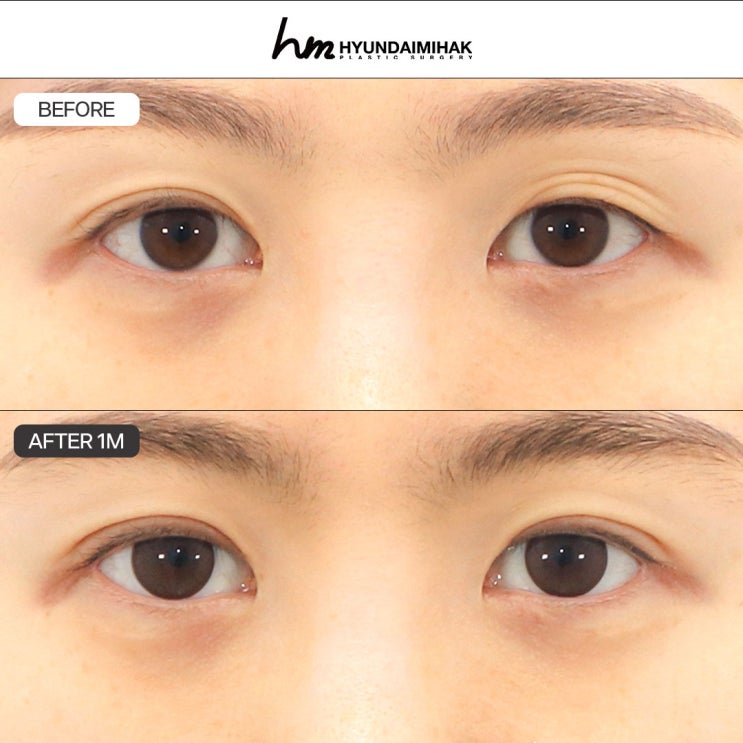
Incisional Double Eyelid Revision FAQ │Please read before deciding on revision surgery
Hello, this is Hyundai Aesthetic Surgery.
Double eyelid revision surgery requires much more careful consideration than the first surgery. Because the design must be redone on tissue that has already been incised once, while adhesions, scars, and disrupted lines are corrected, the procedure is relatively difficult. Today, we have organized only the essential information around the questions most frequently asked by those considering incisional double eyelid revision surgery.
Q1. When is incisional double eyelid revision surgery possible?
In general, revision surgery is most stable when performed 3 to 6 months after the initial surgery. This is because swelling and scarring must subside sufficiently for an accurate line design.
However, early revision surgery may be needed in the following cases.
- When the line height differs significantly between the left and right eyes
- Severe inverted triangular eye shape where the eyelashes poke the eye
- When the incision scar has hardened excessively and the line does not open out at all
- When there is a functional problem that makes it uncomfortable to open the eyes
In these situations, it is advantageous to correct the problem before the tissue hardens further, so surgery may be performed immediately depending on the individual condition.
Q2. In what cases is incisional double eyelid revision surgery needed?
The most common cases seen during revision consultations are as follows.
- When the line is too high or too low
Cases where revision is sought because healing did not match the original design or the preferred style has changed.
- Line loosening / asymmetry
Even with an incision method, if early adhesion is weak, the line may become faint or loosen.
Left-right asymmetry may also occur due to differences in levator muscle strength, swelling, and other factors.
- When scarring remains prominent
With the incision method, scarring does occur, but dark or depressed scars can be improved through revision surgery.
- Sleepy-looking eyes / insufficiently corrected ptosis
Cases where ptosis was not properly corrected during the first surgery or was overcorrected.
- When changing from buried suture method to incision method
If the buried suture method frequently loosens or the eyelid skin is thick, revision surgery is performed to change to the incision method.
Q3. Is incisional revision surgery considered difficult?
It is much more difficult than standard incisional double eyelid surgery. This is because existing scar tissue must be refined, incorrectly formed adhesions must be released, the new line must be fixed securely, and even left-right differences from the first surgery must be adjusted.
Because revision surgery often involves tissue conditions that are difficult to predict, it is safer to entrust it to a specialist with extensive design experience and skill in delicate tissue dissection.
Q4. How long is the recovery period for incisional double eyelid revision surgery?
It is not very different from a standard incision procedure, but because revision surgery involves more tissue trauma, swelling may last somewhat longer.
- Stitch removal: 5 to 7 days
- Light recovery: about 2 to 4 weeks
- Natural-looking impression: 2 to 3 months
- Final settling period: 6 months to 1 year
In particular, areas that had scars may appear to retain some redness, but this fades over time. Since the scar line is reorganized during revision surgery, most cases become much more natural than before.
Q5. Can the scarring become worse?
Scarring is the part many people worry about most. However, when the previous scar is neatly removed and reorganized into a new line, there are many cases where the scar actually becomes less noticeable.
The two key points are as follows.
- Removal of the existing scar + natural connection with normal tissue
- Fine-incision design that considers eyelid skin thickness and fat volume
Professional revision incision surgery includes a process to refine the scar so it is as thin and straight as possible.
Revision incisional double-eyelid surgery is not simply a matter of readjusting the line; it is a highly complex procedure that involves “repairing already damaged tissue and redesigning a new eye shape.” The reasons Hyundai Aesthetic Surgery is recommended by many patients as a revision surgery clinic are as follows.
1. Head surgeons with specialized experience in eye surgery
Our directors specializing in eyes and noses perform the procedures themselves, and with experience in thousands of revision surgery cases, they are highly skilled in tissue refinement, adhesion release, and scar revision.
2. Delicate surgery based on microtissue anatomy
We precisely perform “microtissue dissection,” the core of revision incision surgery, to make existing scars look natural and thin.
3. 1:1 customized design system
After analyzing the causes of problems from the previous surgery, we propose an optimized design that considers each individual’s eye structure, muscle strength, eye proportions, and the presence of ptosis.
4. Easy access, 1 minute from Exit 1 of Sinsa Station
Because revision surgery requires continuous follow-up observation, accessibility to the clinic is very important. Hyundai Aesthetic Surgery is located in the first building from Exit 1 of Sinsa Station, offering excellent access.
Because double-eyelid revision surgery is difficult to reverse again, choosing the right clinic is most important. If you are concerned about even slight dissatisfaction with the line, asymmetry, or loosening, receive a professional consultation at Hyundai Aesthetic Surgery and have your current eye condition accurately diagnosed.
Customer Consultation Center: 02-546-4545 / 02-546-4546 KakaoTalk: @Hyundai Aesthetic Surgery Hyundai Aesthetic Surgery Clinic, Suil Building 2F, 6F, 114 Dosan-daero, Gangnam-gu, Seoul (Nonhyeon-dong) *Weekdays: 10:00 AM ~ 07:00 PM *Saturday: 10:00 AM ~ 04:00 PM *Closed on Sundays and public holidays.