



The eyes are one of the most important features in determining a person’s overall impression. As many people improve the shape of their eyes through various procedures such as double eyelid surgery, ptosis correction, epicanthoplasty, lateral canthoplasty, and lower canthoplasty, eye plastic surgery has become one of the most actively performed procedures in private plastic surgery clinics.
As the number of double eyelid surgery cases has increased, revision surgery cases are also clearly on the rise. Common examples include the so-called “sausage eyes,” where the double eyelid fold is too thick and prominent; severe scarring or loosening of the double eyelid line; overcorrection that makes it uncomfortable to open and close the eyes and causes the mucosa to bulge; and cases where the eye shape is not harmonious with the proportions of the face.
Double eyelid surgery is characterized by a relatively short recovery period and the ability to create a significant improvement in image with even a small change. However, there are many cases in which patient satisfaction decreases or patients experience stress from side effects, such as when surgery is performed in a one-size-fits-all manner, when an eye shape resembling a celebrity is forced despite not harmonizing with the face, or when the procedure is not carried out smoothly due to insufficient experience of the medical team. For this reason, it is most important to carefully review the hospital and surgeon’s skills, experience, and approach before making a cautious decision.
If side effects from eye plastic surgery such as sausage eyes, asymmetry, or scar tissue occur, revision surgery may be considered. Eye revision surgery is generally performed after about 6 months, when the tissue has stabilized following the first surgery, although depending on the condition, it may be performed before 6 months if necessary. It is wise to decide the exact timing of revision surgery after sufficient consultation with a board-certified plastic surgeon.
If a patient decides to undergo eye revision surgery, the surgeon must precisely analyze the causes of dissatisfaction, such as the size and position of the double eyelid line and whether overcorrection is present in a dynamic state. Revision surgery should then be performed using an appropriate surgical method while considering each individual’s amount and condition of eyelid tissue and harmony with surrounding structures in order to avoid a second or third revision. Therefore, choosing the hospital and surgeon for eye revision surgery can be considered even more important than for the initial surgery.
Among revision cases, many involve overcorrection and an excessively high eyelid line, sometimes accompanied by asymmetry. In such cases, the existing fixation is released and the line is reset in an ideal position while ptosis correction is performed at the same time. If hollowing has occurred due to excessive removal of fat around the eyes, micro-fat grafting may also be performed. To create a more natural-looking eye shape, the movement and shape of the eyelids should be evaluated through repeated checks of opening and closing the eyes during surgery.
If the incision scar at the surgical site is severe and noticeable, the procedure is first performed by removing the scarred area and suturing it again. However, because changes in tissue volume often lead to changes in eye shape, many cases proceed as comprehensive revision surgery rather than simple suturing. If excessive scarring causes functional problems, autologous tissue grafting may also be considered.
In this way, for cases of dissatisfaction after eye plastic surgery, revision surgery appropriate to each case must be performed to prevent the need for another revision. Therefore, it is important to meet with a specialist medical team that is more experienced than for the initial surgery.
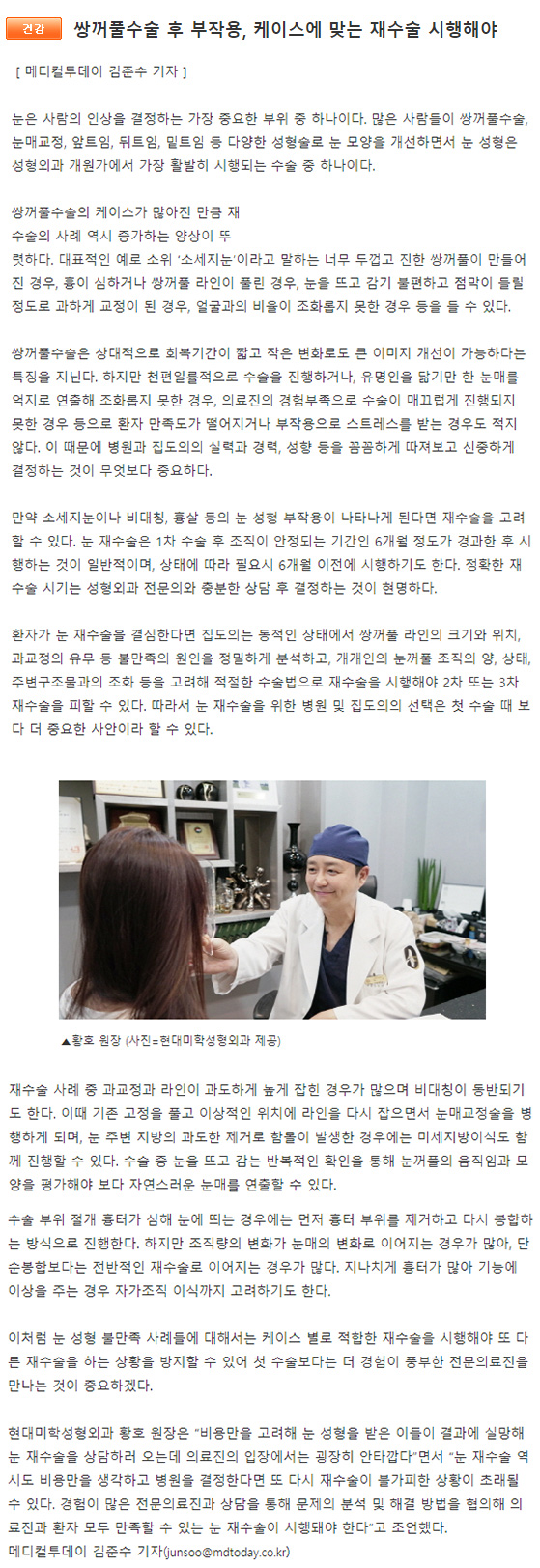
Director Hwang Ho of Hyundai Aesthetic Surgery advised, “It is very unfortunate from a medical team’s perspective when people who underwent eye plastic surgery based only on cost come in for consultation because they are disappointed with the results.” He added, “If patients also choose a hospital for eye revision surgery based only on cost, they may end up in a situation where another revision becomes unavoidable. Eye revision surgery should be performed in a way that satisfies both the medical team and the patient by consulting with an experienced specialist team to analyze the problem and discuss solutions.”
▲ Medical Today news article (2020.05.22) Source: Medical Today · Reported on 2020.05.22 · Reporter Kim Jun-su · Original article mdtoday.co.kr
Information related to Hyundai Aesthetic Surgery Clinic: Gangnam eye plastic surgery information