



Eye surgery can be considered one of the more common cosmetic procedures, but if it is done incorrectly or fails, revision surgery can be among the most challenging.
As many eye surgery cases are being performed, there are also truly many revision cases. Common examples include “sausage eyes,” where the line is too thick and positioned excessively high; loosened lines; lines that are set too deeply; severe remaining scars; overcorrection that exposes the mucosa; lines that do not look harmonious; and dissatisfaction with the shape.
Double-eyelid surgery has the advantage of a relatively short recovery period compared with other cosmetic procedures, and even a small improvement can create a major change in one’s image. However, dissatisfaction or side effects can occur quite often when surgery is performed with a one-size-fits-all method, when a line copied from someone else is forced and looks unnatural, or when the medical team lacks experience. Therefore, it is advisable to carefully review the clinic and the surgeon’s skill, experience, and approach before making a cautious decision.
Revision eye surgery is generally performed after 6 months, when the tissues have stabilized following the first surgery. If necessary, depending on the condition, it may also be performed within 1 month before scar tissue settles. Medical professionals explain that this should be decided after sufficient discussion with a board-certified plastic surgeon.
If a patient decides to undergo revision eye surgery, the surgeon must carefully analyze the causes, such as the size and position of the double-eyelid line in a dynamic state and whether overcorrection is present. Revision surgery should be performed using an appropriate method that considers the amount and condition of eyelid tissue, which can vary from person to person, as well as harmony with surrounding structures, in order to prevent irreversible side effects later.
Among revision cases, overcorrection and lines positioned too high are common, and line asymmetry is often present as well. In such cases, the existing fixation is released and a line is created in an ideal position, together with ptosis correction. If hollowness has occurred due to excessive removal of surrounding fat, micro fat grafting is also performed.
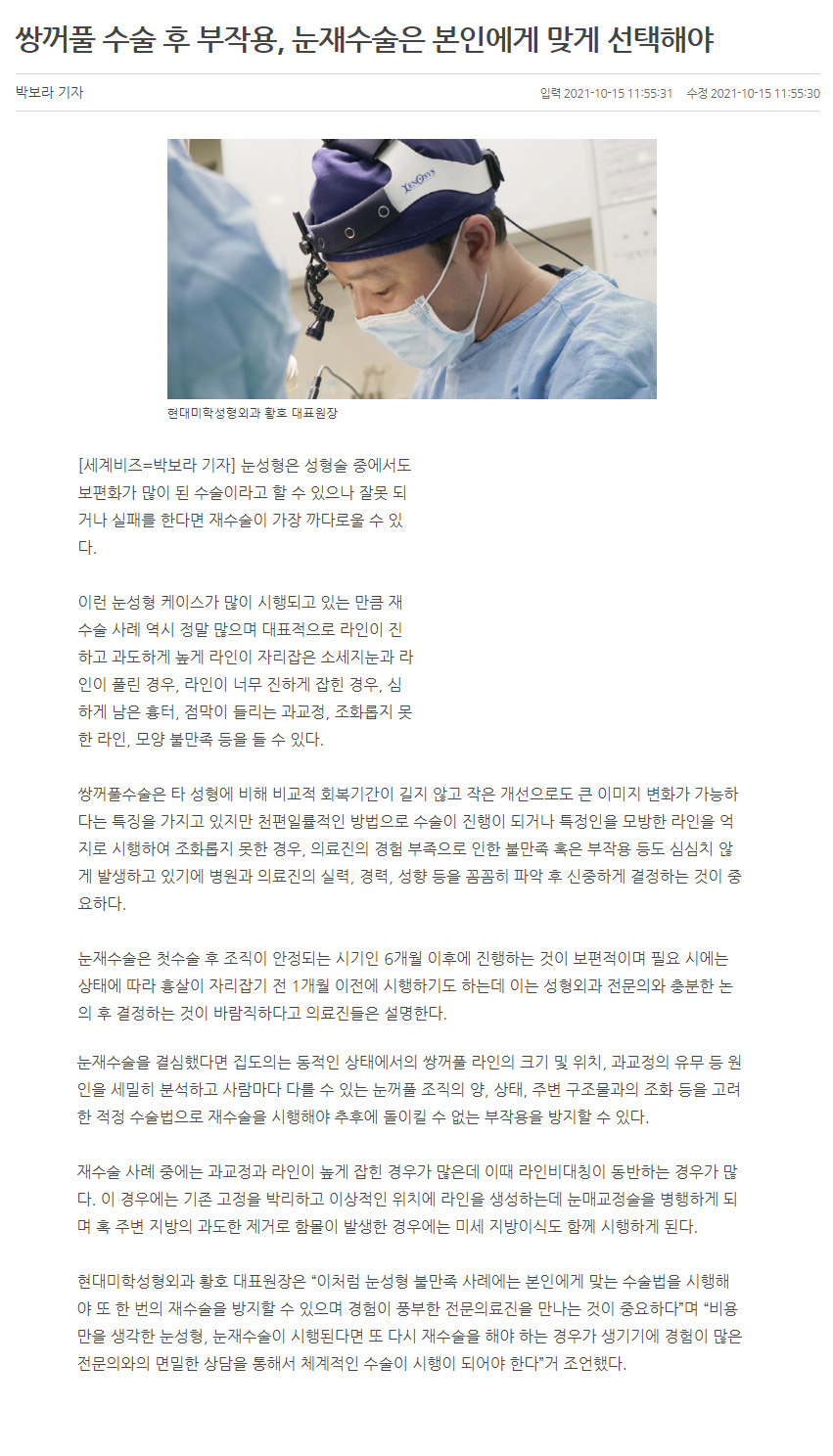
Dr. Hwang Ho, Chief Director of Hyundai Aesthetic Surgery, advised, “In cases of dissatisfaction after eye surgery like these, the surgical method must be tailored to the individual to prevent another revision surgery, and it is important to meet an experienced specialist,” adding, “If eye surgery or revision eye surgery is performed based only on cost, another revision may become necessary, so a systematic surgery should be carried out through a detailed consultation with an experienced specialist.”
▲ World Biz news article (2021.10.15) Source: World Biz · Reported on 2021.10.15 · Reporter Park Bora · Original article at segyebiz.com
Information related to Hyundai Aesthetic Surgery Clinic: Guide to eye surgery in Gangnam