



Because the nose is located at the center of the face, it is a key feature that determines one’s impression, and it can be said that the overall image is shaped by the appearance of the nose.
Accordingly, Westerners who often have high, well-defined noses tend to have a more glamorous and dimensional image, whereas many Asians have a flatter impression due to a low, blunt nasal tip. As a result, more people now consider eyelid surgery and rhinoplasty as active ways to improve appearance-related concerns.
In fact, with recent advances in medicine, various types of rhinoplasty are being performed, including procedures using artificial implants, implant-free rhinoplasty, non-incisional techniques, autologous fat, donated rib cartilage, and autologous rib cartilage. However, for the nose, it is advisable to carefully analyze facial harmony, nasal length and shape, condition, angle, and other factors, and to proceed with rhinoplasty using materials suited to those findings.
This is because if only the nasal bridge is raised with silicone and the shape becomes unnatural, or if surgery is performed using implants or materials that do not suit the individual, there is always a risk of side effects such as a contracted nose, inflammation, and tissue rejection.
For this reason, breast cartilage rhinoplasty, namely autologous rib cartilage rhinoplasty, which can minimize the side effects of rhinoplasty, has recently been actively performed.
Autologous rib cartilage rhinoplasty is a nasal surgery in which cartilage attached between the ribs beneath the chest is harvested and used as an alternative to artificial implants. It provides a sufficient amount of cartilage to elevate the nasal tip and allows for the design of a natural nasal line in patients who feel reluctant about foreign materials such as silicone.
Some people consider autologous rib cartilage rhinoplasty for a more defined nasal line, but if the skin is thin and the implant may show through, or if the skin color changes easily even with minor stimulation, fascia can be used to cover and reinforce the implant or nasal tip.
In addition, because it uses the patient’s own tissue, tissue rejection reactions are also very rare, and the likelihood of side effects such as contracture, inflammatory reactions, or necrosis can be considered relatively low. This autologous cartilage rhinoplasty method is widely used not only for first-time nose surgery, but also for revision rhinoplasty when ear cartilage or septal cartilage is insufficient.
However, in autologous rib cartilage rhinoplasty, it is important from the harvesting stage onward to trim and insert the cartilage appropriately according to the type of rhinoplasty being performed. Therefore, it is advisable to decide after thorough consultation with a board-certified plastic surgery medical team with extensive experience and skill.
Autologous rib cartilage rhinoplasty is a relatively demanding nasal surgery method because only the required amount should be harvested based on a precise diagnosis. This is because the surgical outcome can vary depending on the surgeon’s delicacy and professional surgical technique.
In addition, a systematic surgical plan must be established in advance, and satisfying results can be achieved only when the procedure is performed as a customized one-on-one solution that considers each patient’s condition, nasal line, height, and other factors.
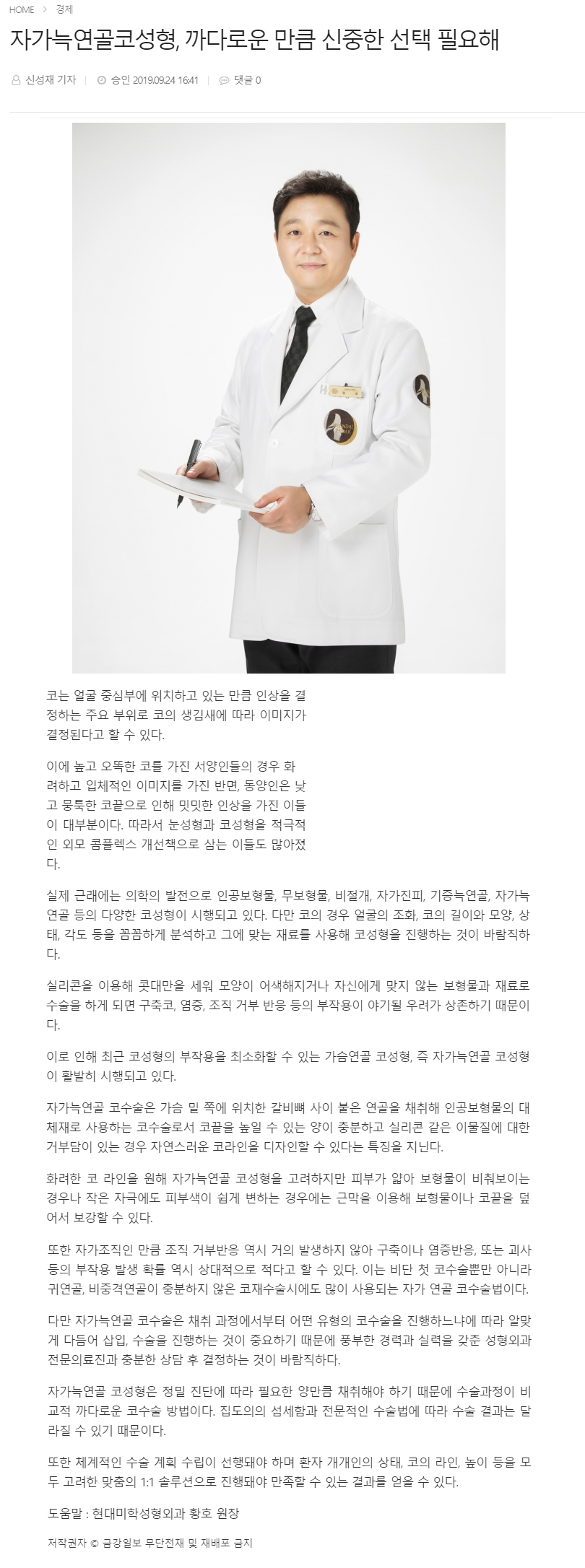
Medical advice: Director Hwang Ho, Hyundai Aesthetic Surgery
▲ Article reported by Geumgang Ilbo (2019.09.24) Source: Geumgang Ilbo · Reported on 2019.09.24 · Reporter Shin Sung-jae · Original article: ggilbo.com
Information related to Hyundai Aesthetic Surgery Clinic: Guidance on Gangnam Rhinoplasty (Implant-Free)